Varada P
UX/UI Designer
No-code Developer
Freelancer
Brand Designer
Dog Lover
Karunyam Website
Care Beyond Cure
At a Glance
Challenge A palliative care organisation serving 3,150+ patients across Kozhikode had no digital presence that matched the depth of their work. Donors couldn't easily give. Volunteers couldn't easily join. The people who needed help most couldn't find it.
Strategy Design a website that leads with human impact, builds trust through transparency, and removes every barrier between the visitor and the action they want to take donate, volunteer, or seek care.
Results A warm, structured, and accessible web presence that communicates 18 years of community care with clarity and compassion.
The Problem
Charitable organisations like Karunyam face a specific digital challenge, their users arrive with different needs, different levels of familiarity, and different emotional states. A single website has to serve all of them, clearly and without friction.
The core problems to solve were:
Donors couldn't act quickly. There was no obvious, prominent donation path. Trust signals, impact numbers, testimonials, transparency about how funds are used, were absent or buried.
Families couldn't find clarity. Patients and caregivers arriving at the site in difficult moments needed to understand immediately what services were available and how to access them. Medical jargon and unclear structure made this harder than it needed to be.
Volunteers had no entry point. People willing to give time had no clear way to start. The organisation relies on community participation, but the website didn't invite it.
The organisation's 18-year story was invisible. Karunyam's credibility, its history, its endorsements from political leaders, doctors, and community figures, its infrastructure built over nearly two decades wasn't being communicated.
Understanding the Users
Three distinct user groups visit the Karunyam website, each with different needs and different emotional contexts.
Donors — local and diaspora Many of Karunyam's supporters are Malayalis in the Gulf, particularly through the Karunyam Qatar and Bahrain chapters. They arrive already willing to give the website's job is to make giving immediate, trustworthy, and emotionally resonant. They want to know their contribution matters and reaches real people.
"The expatriate community from Maniyur Panchayat in Qatar stands committed to extending full support moral, organisational, and humanitarian."
Patients and families Arriving often in distress, these users need to understand quickly: what care is available, whether they qualify, and how to reach someone. Clarity and warmth are non-negotiable. Complexity is a barrier they may not have the capacity to navigate.
Volunteers and community members People who want to contribute time and presence need a clear, low-friction invitation what volunteering involves, what the commitment looks like, and how to take the first step.
Strategy
Lead with human impact, not organisational information
The instinct for most NGO websites is to explain the organisation first its history, its structure, its mission statement. But visitors don't arrive needing to understand the organisation. They arrive needing to feel that the organisation is worth their trust, time, or money.
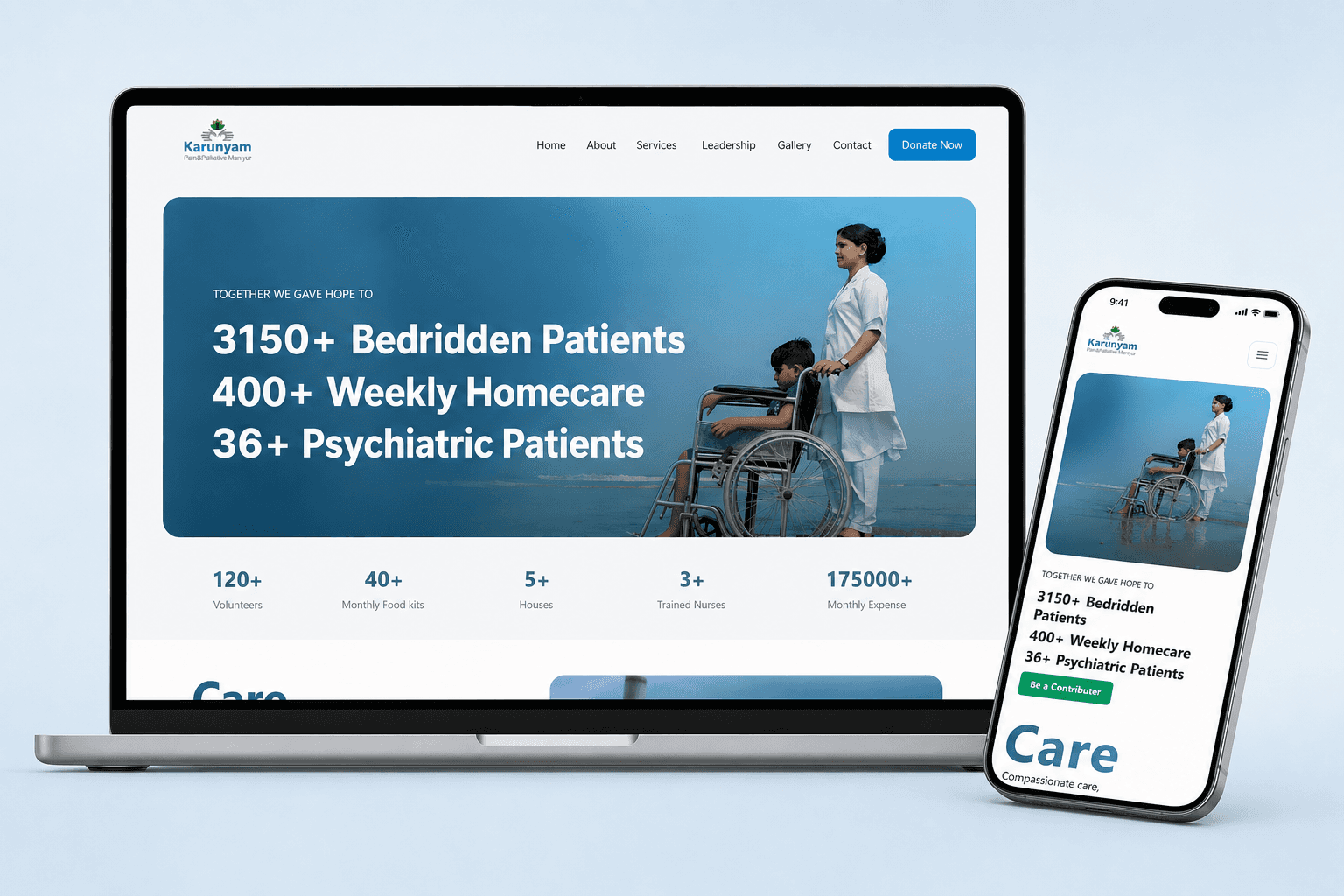
The homepage was designed to lead with impact numbers — 3,150+ patients served, 400+ weekly home care visits, 36+ psychiatric patients supported, before anything else. These numbers do more trust-building in three seconds than three paragraphs of mission copy.
Make donation the most visible action on the site
Every page carries a clear, warm donation CTA. The donate page itself is designed to be fast and frictionless no lengthy forms, no ambiguity about where the money goes. Impact context sits alongside the donation prompt, so the act of giving feels connected to a real outcome.
Services structured for the person in need, not the organisation
Each service was given its own dedicated page with plain-language descriptions of what it involves and who it's for. Medical terminology was minimised. The goal was a family member with no healthcare background being able to read a service page and immediately understand whether it applied to their situation.
Build trust through voices, not claims
Rather than asserting credibility, the website surfaces the voices of those who have witnessed Karunyam's work first-hand doctors, community leaders, political figures across parties, and diaspora chapter heads. These testimonials span the full breadth of the community Karunyam serves, signalling that its impact is recognised by everyone from medical professionals to local government.
The timeline as a trust anchor
Karunyam's growth from a small office in 2007 to a two-storey clinic with an ambulance, physiotherapy unit, and psychiatry clinic represents 18 years of consistent community investment. This history was made visible through a structured timeline not as a vanity section, but as proof of longevity and institutional reliability. For a donor deciding whether to trust an organisation with their money, 18 years of documented, community-endorsed growth is the most powerful argument available.
A tone that matches the work
Palliative care exists at the intersection of suffering and dignity. The visual and verbal tone of the website was designed to reflect this warm without being saccharine, serious without being heavy. Every word choice was considered: the tagline "Care Beyond Cure" communicates the organisation's philosophy in three words.
Key Features
Homepage : Impact numbers lead, donation CTA is prominent, services are immediately accessible.
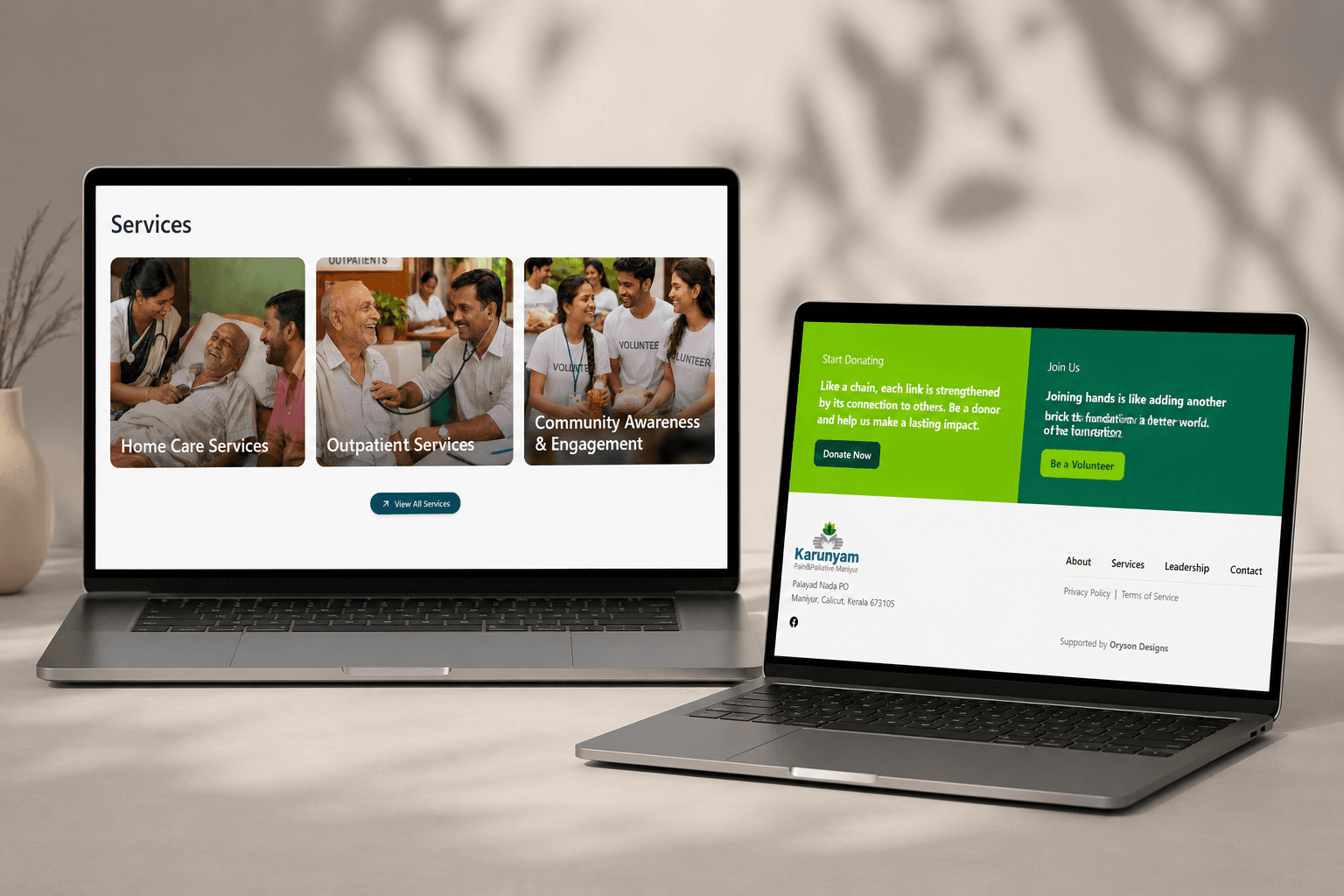
Services section : Eight services, each with its own page, written in plain language for patients and families.
About & Timeline : Eighteen years of growth made visible, building trust through documented history.
Testimonials : Voices from doctors, panchayat presidents, community leaders, and diaspora chapters.
Donate page : Fast, clear, with impact context alongside the giving prompt.
Volunteer page : A warm, low-friction invitation to community participation.
Impact
A website for a palliative care organisation carries a weight that commercial projects don't. The person who finds it at 11pm searching for help for a parent with cancer, the NRI in Qatar who wants to give back to his hometown, the young volunteer looking for meaningful work all of them deserve a digital experience that meets them with clarity and warmth.
The redesigned Karunyam website gives the organisation a presence worthy of its work making it easier to give, easier to find help, and easier to understand why this community institution has earned 18 years of trust.
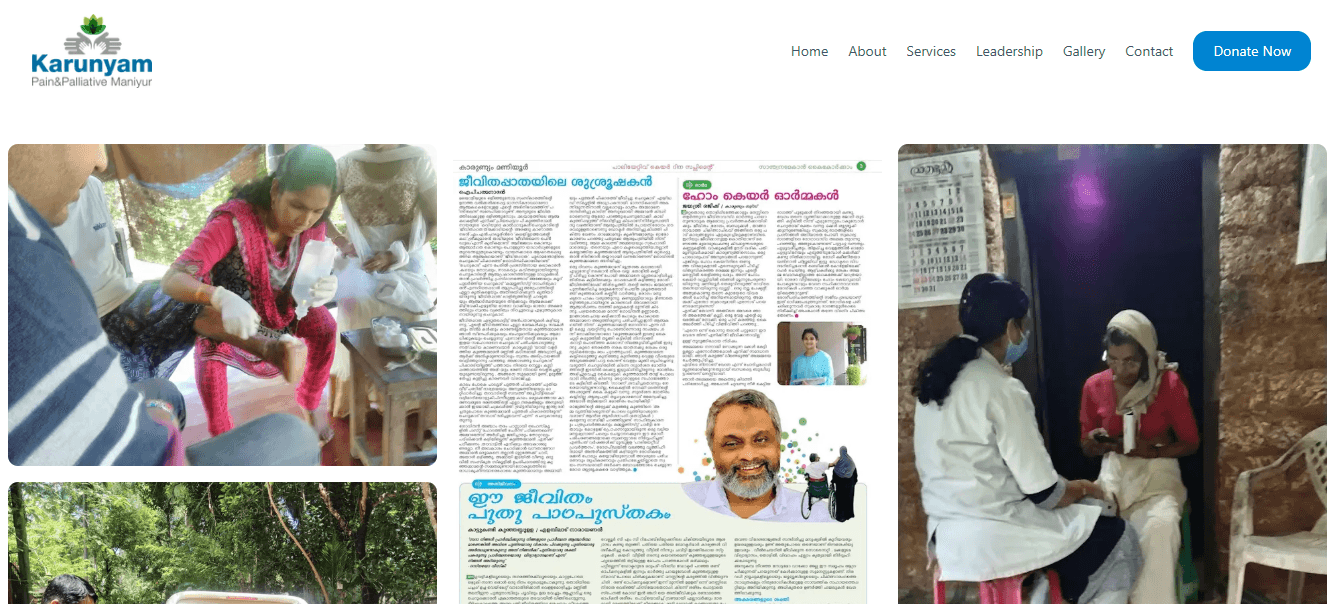
Learnings
Trust is the primary design problem for non-profits. Before a visitor donates, volunteers, or seeks care, they need to trust the organisation. Every design decision — impact numbers, testimonials, the timeline, plain-language service descriptions — was in service of that trust.
Emotional context shapes every UX decision. A family member in crisis reads a page differently than a donor in a comfortable moment. Designing for the harder context first produces a better experience for everyone.
Simplicity is an act of care. For users navigating a difficult life situation, a clear, simple service page isn't a design nicety it's a genuine reduction of burden. Complexity has a human cost.
History is an asset, not an archive. Eighteen years of work, documented and visible, is Karunyam's strongest argument for trust. Making that history legible was one of the most important things the website could do.
The tagline does real work. "Care Beyond Cure" communicates the organisation's entire philosophy — that palliative care is about quality of life, dignity, and human presence, not just medical intervention. Four words that shape how every subsequent page is read.