
Varada P
UX/UI Designer
No-code Developer
Freelancer
Brand Designer
Dog Lover
KENZA Rewards App
Designing a Transparent Reward Experience for the Steel Industry
Project Summary
Kenza Rewards is a mobile application designed for contractors, dealers, and steel purchasers to earn rewards based on their purchases. By uploading GST invoices, users receive points after verification, which can later be redeemed for valuable rewards.
The Problem: User to Target
Contractors, dealers, and steel purchasers struggled with a reward system that lacked clarity in tracking points, understanding invoice verification, and navigating redemption.
Goal: Design the reward experience with better UI/UX, simplified reward tracking, and transparent verification flow to create a more intuitive, trustworthy, and engaging user experience.
Challenge
The lack of clarity
For contractors and dealers who purchase steel regularly, a loyalty program should feel like a genuine benefit — a tangible return on the purchases they're already making. Instead, the existing Kenza system buried that value under layers of friction.
Users uploaded invoices and then … waited. There was no clear feedback on whether their upload was received, no visibility into the verification stage, and no indication of how far away their next reward actually was. The platform asked for trust but offered nothing in return.
Strategy
Designing for trust through transparency
The design centered on one insight: trust is built through visibility. Every stage of the rewards loop upload, verification, points, redemption needed to be surfaced clearly and given a sense of forward momentum.
A step-by-step invoice flow with live status
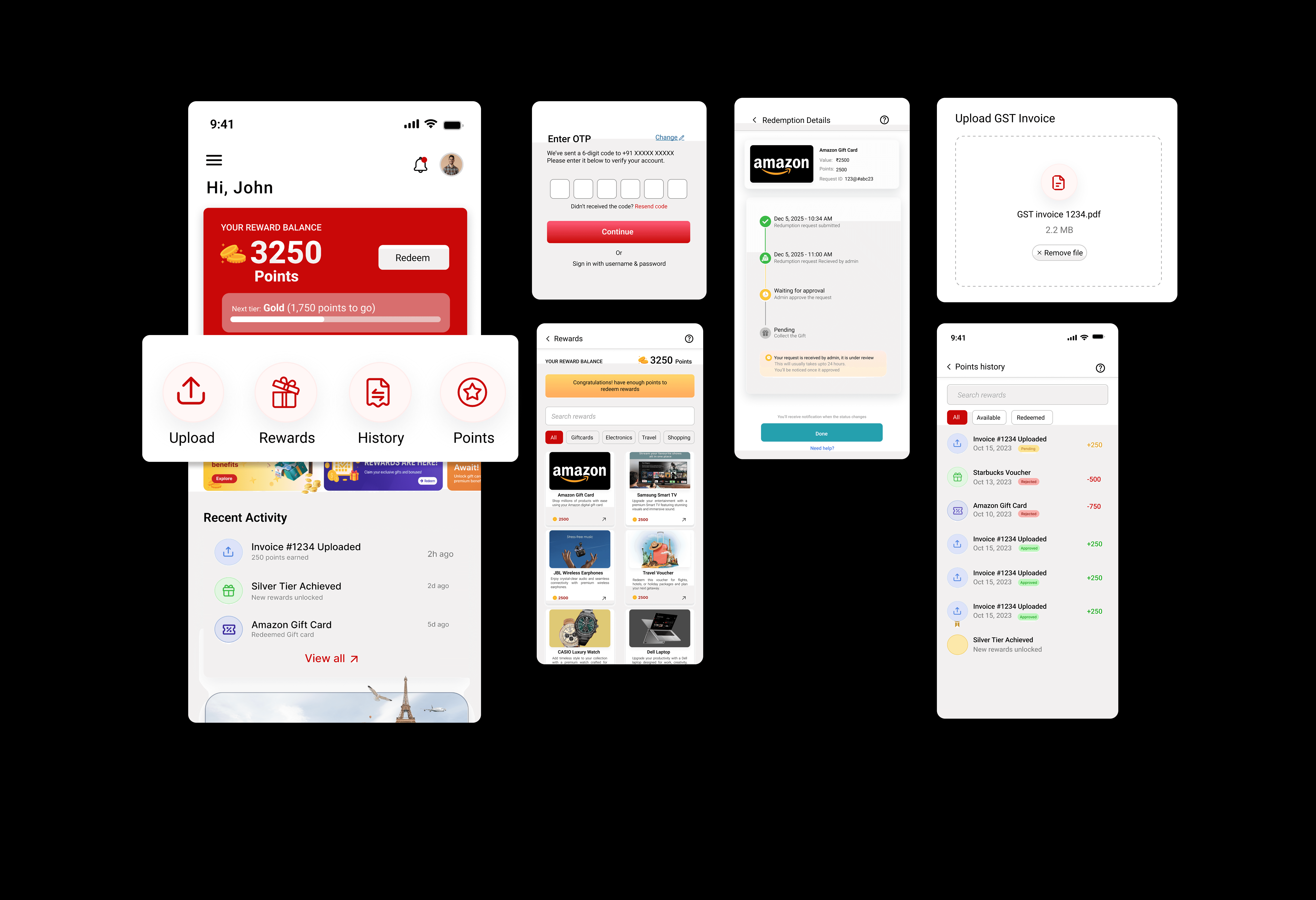
Rather than treating invoice upload as a one-and-done action, I redesigned it as a trackable journey. After uploading, users are immediately shown a status card Submitted → Under Review → Verified → Points Added — with estimated timeframes at each stage. This transforms a black box into a progress bar the user can trust.
The upload interface itself was simplified to a guided three-step flow: photograph or select invoice → confirm details → submit. Clear error states and inline validation prevent silent failures.
A home screen built around momentum
The home screen leads with the user's current point balance prominently displayed, followed by a visual progress indicator showing how many points remain until their next reward tier. A recent activity feed lets users see exactly which invoices earned which points.
This shifts the emotional experience from confusion to anticipation users always know where they stand and what they're working toward.
A redemption catalogue that actually converts
The original redemption experience lacked structure rewards were listed without context, and users didn't know what was achievable. The new catalogue organises rewards by point cost with a clear "You can redeem this" indicator based on the user's current balance. Categories (gift cards, electronics, travel) are filterable, and a persistent "Points needed" label on locked items motivates future purchases rather than discouraging present ones.
Design system built for clarity at scale
The visual language built on a red, black, gold, and green palette with Roboto — was refined to create a consistent hierarchy. Red anchors the brand and CTAs. Gold signals achievement and reward value. Green confirms success states. This colour logic is applied consistently so users learn to read the interface intuitively, without needing to read copy.
Iterating from paper to pixel
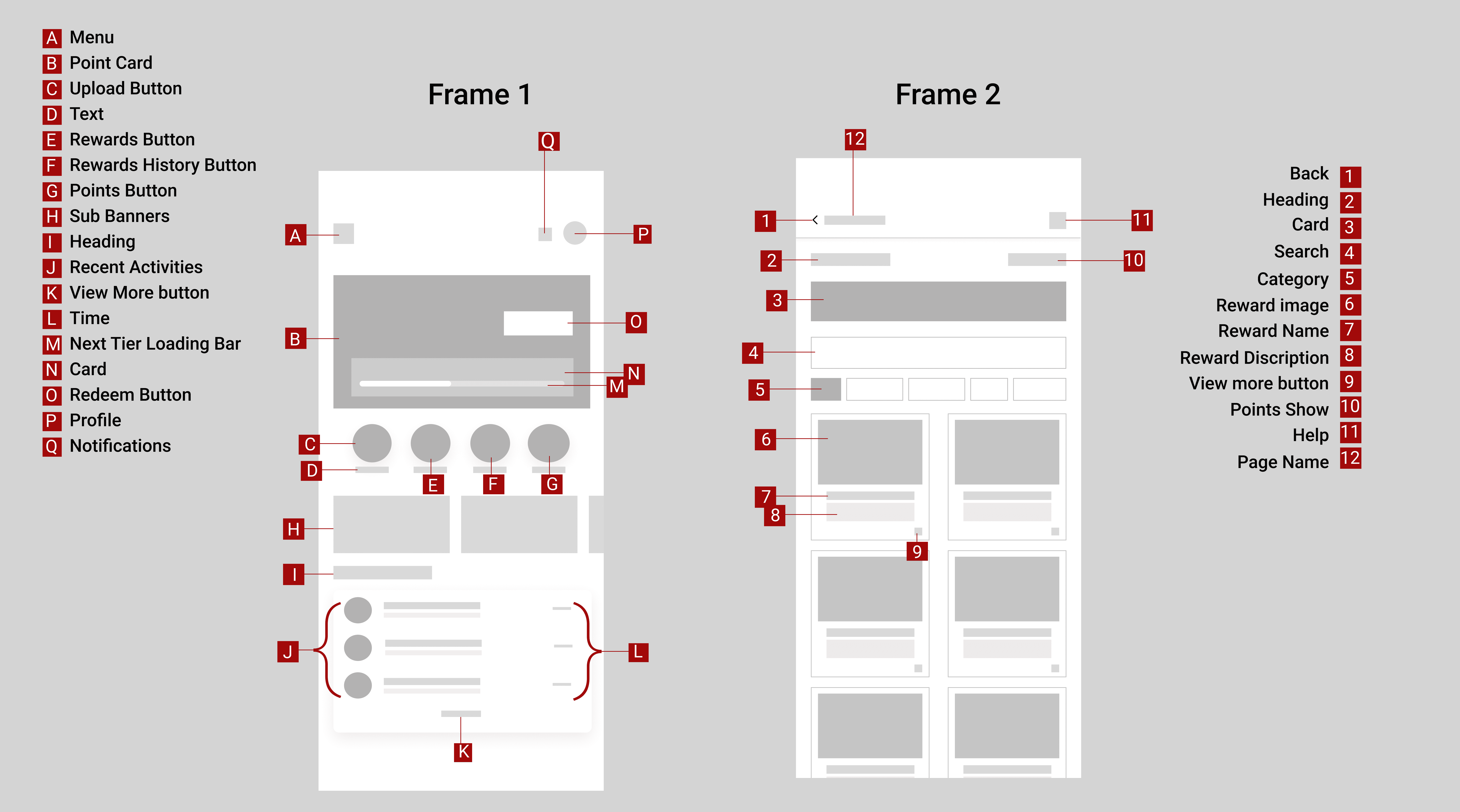
The design moved through three fidelity stages: lo-fi wireframes to validate the core flows with stakeholders, mid-fi prototypes to test navigation patterns, and high-fi screens to validate visual design and micro-interactions before handoff.
Results
Built the Kenza Rewards experience from the ground up, transforming a fragmented and unclear system into a structured, transparent, and user-friendly product. Since the primary users are mostly aged 30 and above, the design focused on simplicity, clear navigation, and making all key actions easy to find and understand. UX research on this age group shows that users prefer minimal interfaces, predictable flows, and quick access to essential functions without unnecessary complexity. By improving visibility across invoice verification and point tracking and connecting every step from upload to redemption the experience reduces confusion, builds trust, and enables more confident and seamless engagement.
The Approach: Elevating an Existing Experience
Results & Impact
This project established a clear and scalable foundation for a reward system that previously lacked structure and trust. By building the experience from scratch, the product shifted from a confusing process to a usable and reliable system.
By focusing on users aged 30 and above, the design prioritizes clarity, easy navigation, and accessible functionality. Improved visibility across reward tracking, invoice verification, and redemption builds user trust, while the structured and consistent design approach supports long-term engagement and future scalability.
Learnings
Transparency is a feature, not an afterthought. Users don't abandon platforms because the reward isn't good enough — they abandon them because they can't see the value. Making every stage of the journey visible is itself a product decision.
Progress is motivating. Ambiguity is not. A user who knows they're 200 points away from a gift card behaves differently from one who has no idea where they stand. Designing for visible progress drives the behavior the platform needs.
Simplicity earns trust faster than aesthetics. The visual improvements mattered, but the biggest trust signal was a clear, predictable flow. When users know what happens next, they feel in control — and in control users engage more.
Colour can carry meaning if used consistently. Applying a deliberate logic to the colour system (red = action, gold = reward, green = success) reduces cognitive load and makes the interface feel cohesive even across very different screens.
Summary
Kenza Rewards is a mobile application designed to simplify how contractors and dealers earn and manage rewards. Built from the ground up, the experience focuses on clarity, transparency, and ease of use—especially for users aged 30 and above. By streamlining invoice uploads, making reward tracking visible, and simplifying redemption, the product transforms a previously confusing process into a clear and reliable system. The result is a more intuitive experience that builds user trust and encourages consistent engagement.